Raphael and Ella: The Confidence Trap

A Children’s Story About Social Media, Self-Sabotage, and Building Real Confidence

Raphael and Ella sat next to each other in class, shared snacks at break, and walked home together every day. But lately, Raphael had been acting different.

He was tired. Grumpy. His eyes had dark circles underneath them. His homework was late. He looked scruffy and he’d not been seen playing football —his favourite thing in the world.

Ella noticed everything.

“Raphael, are you okay?” she asked one morning. “You look exhausted.”

Raphael yawned loudly. “I’m fine. Just busy.”

But Ella wasn’t convinced. She knew Raphael too well.

That night, Raphael’s dad called up the stairs. “Raphael! Bedtime! Put your tablet away!”

“I will, dad!” Raphael called back.

But he didn’t.

Instead, Raphael shut his bedroom door. He pulled the duvet over his head. And he opened TikTok.

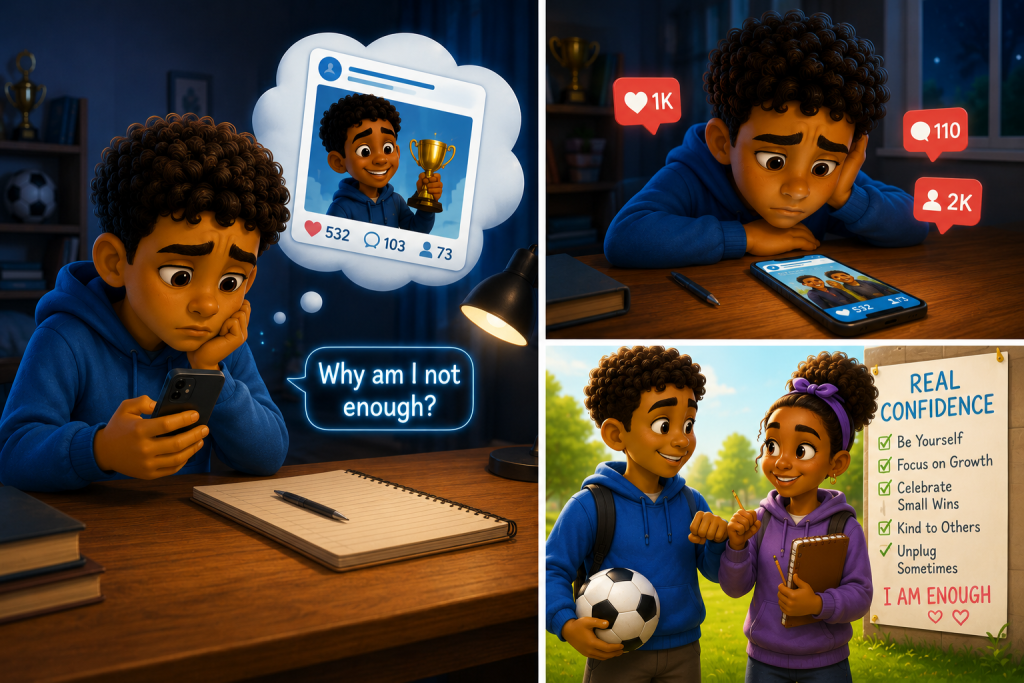
For hours, he scrolled. He watched teenagers showing off their six-packs. He watched kids his age doing backflips and dancing. They all looked so confident. So popular. So perfect.

Raphael felt small.

Then he had an idea. He created a video and took a photo of himself, without a top on. He used a filter to make his face look older. He sucked in his stomach and pretended he had muscles. He captioned it: “16 years old. Gym life. Who’s with me?”

Likes flooded in. Comments poured out.

“Bro, you’re huge!”

“Teach me your routine!”

Raphael’s heart raced. This felt amazing. People liked him. They thought he was cool.

He stayed up until 4am—replying to comments, messaging strangers, chatting with friends who were also awake.

When his dad knocked on his door at 10pm, he was still awake, dad tried to leave his room door open, but Raphael asked for it to be shut. “I feel more secure” he says.

At 12 midnight dad came around Raphael’s room and he pretended to be asleep. He hid the tablet under his pillow.

The next morning, Raphael couldn’t wake up at 5.30am, which is Raphael’s usual wake up time. He has been more tired in recent weeks, prompting his mum to contact the doctors. “Perhaps his Iron level is low” says Raphael’ mum!

The alarm continued that morning ! His dad called him three times. Finally, he opened the door and pulled off his duvet.

“Raphael! You’re going to be late!”

Raphael groaned. His head pounded. His eyes stung. He dragged himself out of bed, skipped breakfast, and ran to school, once again looking scruffy, hair not combed and wearing easy fit trainers , instead of proper school shoes

At school, Raphael could barely keep his eyes open. During maths, he put his head on his desk. During English, he forgot his homework—again.

“Raphael, this is the third time this week,” his teacher said. “What’s going on?”

“I don’t know, Miss,” Raphael mumbled. “I just can’t concentrate.”

At lunch, Ella found him slumped on a bench.

“Raphael, talk to me,” she said gently. “What’s really happening?”

Raphael hesitated. Then it all came out.

“I’ve been staying up late on TikTok,” he confessed. “I made a video pretending I’m 16 with six-packs. Everyone thinks I’m cool. I got hundreds of likes. But now I’m so tired I can’t do anything. I can’t wake up. I can’t exercise. I can’t even think straight.”

Ella’s eyes widened. “Raphael! You’re lying about your age? You’re talking to strangers? That’s dangerous!”

“I know,” Raphael whispered. “But I wanted to feel confident. Everyone online looks so perfect. I wanted to be like them.”

Ella took a deep breath. “Raphael, that’s not confidence. That’s a trap. Real confidence doesn’t come from filters and fake muscles. It comes from doing hard things—like waking up early, exercising, being honest and prioritising learning!

Ella pulled out her tablet. But instead of showing Raphael a video, she showed him something else.

“Look,” she said. “I use social media too. But I use it to learn.”

She scrolled through her feed. There were videos about knitting patterns. Maths tutorials. Science experiments. Positive affirmations and some piano tutorials.

“I follow people who teach me things,” Ella said. “I don’t compare myself to anyone. And I never, ever talk to strangers. Social media can be good—but only if you use it wisely.”
Raphael stared at her screen. “You use social media for school?”

“Sometimes,” Ella said. “But I also set a timer. Thirty minutes a day. Then I switch it off and go to bed. No excuses.”

Raphael felt silly. “I’ve been wasting hours. Hours I could have spent sleeping. Or exercising. Or actually getting better at things.”

“That’s called self-sabotage,” Ella said. “When you get in your own way. You wanted confidence, but you stayed up late and lied. Now you’re tired, your grades are slipping, and you’ve lost trust with your parents.”

That evening, Raphael’s parents sat him down.

“Raphael, we found your tablet history,” his dad said quietly. “You’ve been staying up until 4am. You’ve been talking to strangers and having needless conversations about people’s friendship and relationships online. You lied to us about going to bed.”

Raphael’s face burned. “I’m sorry,” he whispered.

“We trusted you,” his mum said. “And that trust is broken. When you break trust, it takes time to rebuild. For the next month, your tablet stays in the living room. No closed doors. No screens after 8pm.”

Raphael nodded. His heart felt heavy.

“But we’re not giving up on you,” his dad added. “We want to help you build real confidence. Not fake confidence.”

The next morning, Raphael’s alarm went off at 5.30am. He wanted to snooze it. He wanted to roll over and sleep.

But he remembered Ella’s words. Real confidence comes from doing hard things.

He got up. He brushed his teeth. He did ten push-ups. His arms trembled. It wasn’t a six-pack. It wasn’t impressive. But he did it.

Every morning that week, Raphael got up early. He exercised—just a little. He went to bed on time. He used social media for only thirty minutes—and only to watch educational content.

By Friday, Raphael felt different. He had more energy. He could concentrate in class. He even scored a goal in football practice—his first in weeks!

At lunch, Ella smiled. “You look different, Raphael. Happier.”

“I feel different,” Raphael admitted. “I’m not pretending to be someone I’m not. I’m just… me. And it’s not perfect. But it’s real.”

“That’s confidence,” Ella said. “Real confidence isn’t about likes or followers. It’s about trusting yourself. Knowing you can handle things—even hard things.”

Raphael nodded. “I also learned something else. When I broke my parents’ trust, it hurt them. And it hurt me too. Now I have to earn it back—one day at a time.”

“That takes patience,” Ella said. “But you’re doing it.”

That night, Raphael opened TikTok. He didn’t post a video. He didn’t scroll for hours.

Instead, he wrote one comment on a maths tutorial: “Thanks for this. It really helped me understand fractions.”

Then he put the tablet down, brushed his teeth, and went to bed—with his door open.

His mum walked past his room and smiled. “Goodnight, Raphael.”

“Goodnight, Mum,” he said. “I love you.”

She paused. “I love you too, sweetheart. And I’m proud of you.”

For the first time in weeks, Raphael fell asleep feeling proud of himself too.

What Raphael and Ella Learned About Confidence and Social Media:

  • Social media can be a trap; Fake filters and likes don’t build real confidence
  • Social media can be a tool Use it to learn, not to compare or lie
  • Peer pressure is powerful; Don’t let others make you feel small
  • Self-sabotage hurts you; Staying up late and lying wastes your potential
  • Lost trust must be earned back; Broken trust takes time and honesty to rebuild
  • Real confidence comes from effort Wake up early, exercise, and do hard things
  • Time is precious Don’t waste hours scrolling—use your time wisely
  • Online safety matters Never talk to strangers or share personal information

Raphael and Ella: The Courage to Show Your Heart

A Children’s Story About Vulnerability, Safe Spaces, and Emotional Intelligence

Raphael and Ella had learned many things together. Self-respect. Gratitude. Attitude. But there was one lesson that felt scarier than all of them.

Vulnerability.

Raphael had been acting strange all week. He was quiet. He snapped at his little sister. He looked disorganised and even went to school forgetting the print out of his completed assignment and didn’t comb his hair.

Ella noticed everything.

“Raphael,” she said softly. She had noticed Raphael sitting quietly at a corner in a very noisy assembly hall. Raphael would usually be part of the noise makers, but not today. “What’s going on?” she asked.

“Firstly Raphael, your hair looks rough,” she said gently. “And then you don’t appear to have a print out of your assignment with you.”

“Nothing,” Raphael mumbled. “I’m fine.”

But he wasn’t fine. His eyes were red. His shoulders were slumped and of course his hair looked coarse, dry and frizzy!

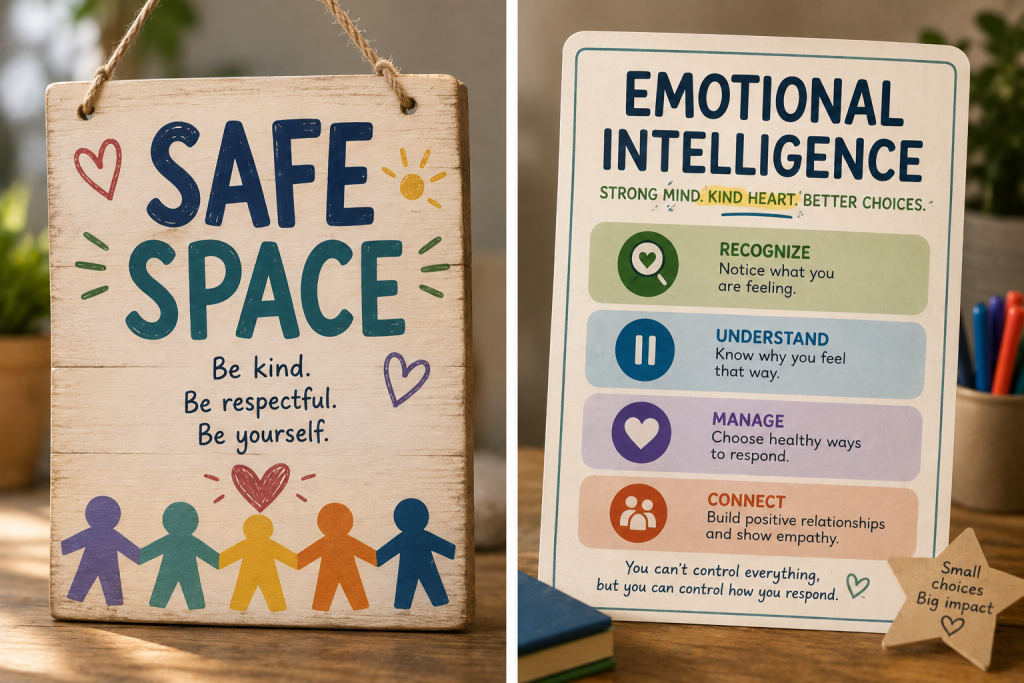
Ella sat beside him. “You don’t have to tell me. But I’m here. And whatever it is, I won’t laugh. I won’t tell anyone. This is a safe space.”

Raphael looked at her. His lip trembled.

“My dad bought a business,” Raphael said quietly. “It’s three hours away. He has to travel there every week. He’s exhausted. He’s stressed. And now he’s talking about moving us closer to the business.”

Ella’s eyes widened. “Moving? Away from here?”

Raphael nodded. Tears spilled down his cheeks. “I don’t want to leave. I don’t want to leave this school, I don’t want to leave my football team. But Dad says the long travel is making him tired and stressed. He thinks it’s affecting everything—even my attitude at home, at school and at football.”

Ella didn’t say, “It’ll be okay.” She didn’t try to fix it. She just sat with him and let him cry.

“Thank you for telling me,” Ella said gently. “That took courage. Being vulnerable means sharing your feelings even when you’re scared. You trusted me with something real.”

Raphael wiped his eyes. “It feels lighter. Like I was carrying a heavy rock and I put it down.”

“That’s what vulnerability does,” Ella said. “It shares the weight.”

Later that day, Raphael’s teacher, Mrs. Patel, noticed he seemed distracted.

“Raphael, is everything alright? You look unusually rough and upset.”

Raphael hesitated. Mrs. Patel was kind. She always listened. But the classroom was full of other students. Everyone could hear.

“I’m just worried about something,” Raphael said quietly. “My dad bought a business far away. He’s always travelling. Now he wants to move us closer.”

Mrs. Patel’s face softened. “Thank you for sharing, Raphael. That must be very stressful.”

But before Raphael could say anything else, some boys at the back started whispering.

“Moving?” one of them snickered. “Where to? Some tiny village school?”

“Yeah,” another boy laughed. “Probably no football team there. Or maybe they play on a muddy field with cows.”

Raphael’s face burned. His stomach twisted. He hadn’t meant for everyone to hear. He had just answered Mrs. Patel honestly.

“Shut up!” Raphael snapped, his voice shaking. “You don’t know anything!”

The boys laughed louder. “Scared of cows, Raphael?”

Raphael became even more upset despite Mrs. Patel trying to calm the situation down. “Keep quiet everyone. Be kind to Raphael,” she said.

Ella found him sitting quietly at the canteen. His face was wet with tears and anger.

“Raphael! What happened?”

“I told Mrs. Patel about the move,” Raphael said, his voice cracking. “And everyone heard. Those boys—they mocked me. They said I’d go to some rubbish school with cows.”

Ella’s expression turned serious. “Raphael, that wasn’t a safe space. The classroom is public. Anyone can hear.

Being vulnerable is brave—but you have to choose the right time, the right place, and the right people.”

Raphael wiped his eyes. “I thought Mrs. Patel was safe.”

“She is,” Ella said. “But the classroom isn’t. She couldn’t control what the other kids heard or said. That’s not her fault. But it’s a lesson for you. Save your big feelings for private spaces—with trusted people.”

Raphael nodded slowly. “So vulnerability is good, but not with everyone, everywhere?”

“Exactly,” Ella said. “Safe spaces are with people who have earned your trust. Not with strangers. Not in front of a whole class. And definitely not online.”

Ella pulled out her tablet. “Speaking of online—look at this.”

She showed Raphael a pop-up ad: “FREE ROBUX! CLICK HERE!”

“See this?” Ella said. “This is a trap. If you click it, they ask for your name, your school, your password. They use your trust to steal from you. That’s vulnerability in a dangerous way.”

Raphael nodded. “So being vulnerable online is bad?”

“Not always,” Ella said. “But you have to be smart. Never share personal information. Never click unknown links. Never tell strangers your feelings or secrets. That’s not a safe space—that’s a danger zone.”

That evening, Raphael sat down with his dad.

“Dad, I need to talk to you. For real.”

His dad put down his laptop. “Of course, son. What’s on your mind?”

Raphael took a deep breath. “I’m scared about moving. I don’t want to leave my school. I don’t want to leave my team. But I also see how tired you are. I know the travel is hard. I know it’s affecting everything.”

His dad’s eyes softened. “Raphael, my preferred option is to remain here to keep you at your school and your team but your attitude and standards needs to improve. It causes your mum and I additional stress.”

“I understand daddy,” Raphael admitted. “But I want to be honest. I want to find a way through this together. Maybe we don’t have to move. Maybe there’s another solution.”

His dad pulled him into a hug. “Thank you for telling me, son. That took real courage. Let’s figure this out together.”

The next week, Raphael’s dad found a solution. He hired a manager to run the business three days a week. He reduced his travel to just one day. No more relocation. No more moving.

Raphael felt like the world had lifted off his shoulders.

He found Ella at the playground.

“I want to thank you,” Raphael said. “You were my safe space. You didn’t judge me. You didn’t tell anyone. You just listened. And you taught me when NOT to share.”

Ella smiled. “That’s what friends do.”

“I also learned something else,” Raphael said. “Being vulnerable with everyone is dangerous. Those boys used my feelings to hurt me. I have to choose wisely. Safe people. Safe places.”

Ella nodded. “Vulnerability is a superpower—but like all superpowers, you have to use it responsibly. Share your heart with safe people. Protect it from unsafe ones. And never let anyone make you feel bad for having feelings.”

Raphael grinned. “Can I be vulnerable with you again?”

“Always,” Ella said. “That’s what safe spaces are for.”

The next day at school, one of the boys who had mocked Raphael came up to him.

“Hey, sorry about the cow joke,” the boy mumbled. “That was mean.”

Raphael looked at him. He remembered how it felt to be mocked. He also remembered that vulnerability is a gift you choose to give—not everyone deserves it.

“Thank you for apologising,” Raphael said carefully. “But next time, think before you speak. You don’t know what someone else is going through.”

The boy nodded and walked away.

Ella appeared beside Raphael. “That was mature. How did you stay so calm?”

Raphael smiled. “Because I learned something. My feelings are precious. I only share them with people who have earned the right to hear them. Everyone else just sees my smile.”

Ella high-fived him. “That’s emotional intelligence. And vulnerability. Together.”

LessonWhat it Means
Safe spacesShare your feelings with people who have earned your trust
Telling the truthHonesty with safe people lightens heavy feelings
TransparencyBeing open helps others understand and support you
When NOT to shareAvoid sharing big feelings in public spaces or with strangers
Online safetyNever share personal information or click unknown links
Protecting yourselfChoose wisely who gets to hear your heart