
Raphael and Ella: The Given

A Children’s Story About Entitlement, Humility, and Earning Your Place
The Playground Conversation
It was break time. Ella found Raphael sitting on the low wall by the sports hall, staring at nothing. His bag was on the ground. His shoulders were down.
“Raphael,” she said, sitting beside him. “What’s happened?”
Raphael didn’t answer straight away. Then he said, “I’ve been dropped from football. And rugby.”
Ella’s mouth opened. “Both? Why?”
“Attitude. Low level. Missing training.” He counted them off like they were someone else’s crimes. “Mr. Robertson said I’ve been ‘coasting on talent.’ Coach Kigali said my head’s not in it.”
“But you love rugby,” Ella said. “You were the best tackler in Year 8.”
“I know,” Raphael said bitterly. “That’s what I told them.”
Ella was quiet for a moment. Then she asked, “What happened this week, Raphael? Start from the beginning.”
The Phone
So Raphael started from the beginning.
“On Sunday, I asked Mum about the phone. I said, ‘So can I have it on Tuesdays and Thursdays now? Since I’ve earned trust back?'”
Ella nodded. “That sounds reasonable.”
“She said no.”
“Did she say why?”
Raphael looked away. “She said the phone isn’t a given. She said I don’t get it because I’ve earned it — I get it because she and Dad decide when it’s appropriate. And that I’d been doing well, but it doesn’t turn into a rule.”
Ella nodded slowly. “So she was saying the phone is a privilege, not a right.”
“Yeah, well.” Raphael shrugged. “It felt like she was taking it back. Like none of my effort counted.”
“And how did you respond?”
Raphael was quiet.
“You sulked, didn’t you?”
“I didn’t sulk,” Raphael said. “I just… I didn’t talk to them. On Monday morning I came down, ate, and left. No ‘good morning.’ No hug. Usually Dad gives me the pep talk before school — ‘big day, head up, do your best.’ He didn’t. He just watched me leave.”
Ella winced. “That must have felt horrible for him too.”
“I didn’t care at the time,” Raphael admitted.
The Low Level
“And then what?” Ella asked.
“Assembly ran over. I came back to class late. Mr. Tillie gave me a low level.”
“Was it your first one?”
“No. Dad had warned me about it weeks ago. He said, ‘Raphael, you’ve had two lates this term. Don’t get a third — it’ll go on your record.'”
“And you got a third.”
“I got a third,” Raphael said. “And when Dad found out, he was really upset. More than I’ve seen him in ages. He said it wasn’t about being late. It was that he’d told me, I’d ignored him, and I didn’t seem to care.”
“Did you apologise?”
Raphael shook his head.
“Not even when he went quiet?”
“I thought he’d get over it,” Raphael said. “I thought he was overreacting.”
Ella looked at him for a long moment. “Raphael, can I say something? And will you actually listen?”
Raphael nodded.
What Ella Said
“You feel entitled.”
Raphael frowned. “Entitled to what?”
“To the phone. To your dad’s pep talk. To your place in the team. To being trusted.”
“But I earned those things!”
“Some of them,” Ella agreed. “And then you lost some of them. But here’s the thing — even the ones you’ve earned aren’t given. They’re kept. Every single day, by how you act.”
Raphael started to argue, but Ella kept going.
“Your mum didn’t say the phone was gone forever. She said it isn’t a given. That’s true. Nothing is. Not my place at the piano either — if I stopped practising, my teacher would drop me. Not my parents’ trust. Not yours.”
“That’s harsh,” Raphael muttered.
“It’s honest,” Ella said. “And here’s the harder part. When your dad went quiet, that was him being hurt. He wasn’t overreacting. He was waiting for you to say sorry. You didn’t. So he stopped taking you on the morning walk. He stopped the training sessions. And then the coaches dropped you — because if you don’t show up, mentally or physically, there’s no place for you.”
Raphael’s eyes stung. He stared at the ground.
“Nobody owes you your place, Raphael,” Ella said gently. “You have to keep earning it. That’s not unfair. That’s how it works.”

Raphael Goes Home
That evening, Raphael found his mum in the kitchen. He stood in the doorway for a moment.
“Mum?”
She turned. Her face was tired.
“I’m sorry,” Raphael said. “About Sunday. About the phone. You weren’t taking anything back. I just didn’t want to hear it.”
His mum put down the cloth she was holding.
“And I’m sorry for how I left on Monday,” he continued. “I was horrible. You didn’t deserve that.”
His mum’s eyes filled. She opened her arms. Raphael walked into them.
Then he found his dad in the garage.
“Dad.”
His dad looked up. He didn’t say anything.
“I’m sorry about the low level. And about not apologising when you told me off. You weren’t overreacting. I was being… entitled.”
His dad’s expression changed. “Where did you get that word?”
“Ella.”
His dad almost smiled. “She’s a good friend.”
“She is.” Raphael took a breath. “Dad, can we go on the morning walk again? I miss it. Not just the training — the walk.”
His dad was quiet for a long moment. Then he nodded. “Tomorrow. 5:30. Don’t be late.”
“I won’t.”
Facing the Coaches
The next day, Raphael went to Mr. Kigali first.
“Sir, I wanted to apologise. I’ve been coasting. I haven’t been putting in the work, and I blamed everyone else for it.”
Mr. Kigali studied him. “Why should I put you back in the squad?”
“Because I’ll train properly. Every session. And if I don’t, you can drop me again — and I won’t argue.”
Mr. Kigali nodded slowly. “Come to training Thursday. Not the squad — just training. Show me.”
Then Raphael found Coach Robertson.
“Sir. I’m sorry. I didn’t show up mentally for the last few weeks. It won’t happen again.”
Coach Robertson folded his arms. “Words are cheap, Raphael.”
“I know, Sir. That’s why I’m asking you to watch me.”
The Comeback
Raphael trained like he’d never trained before.
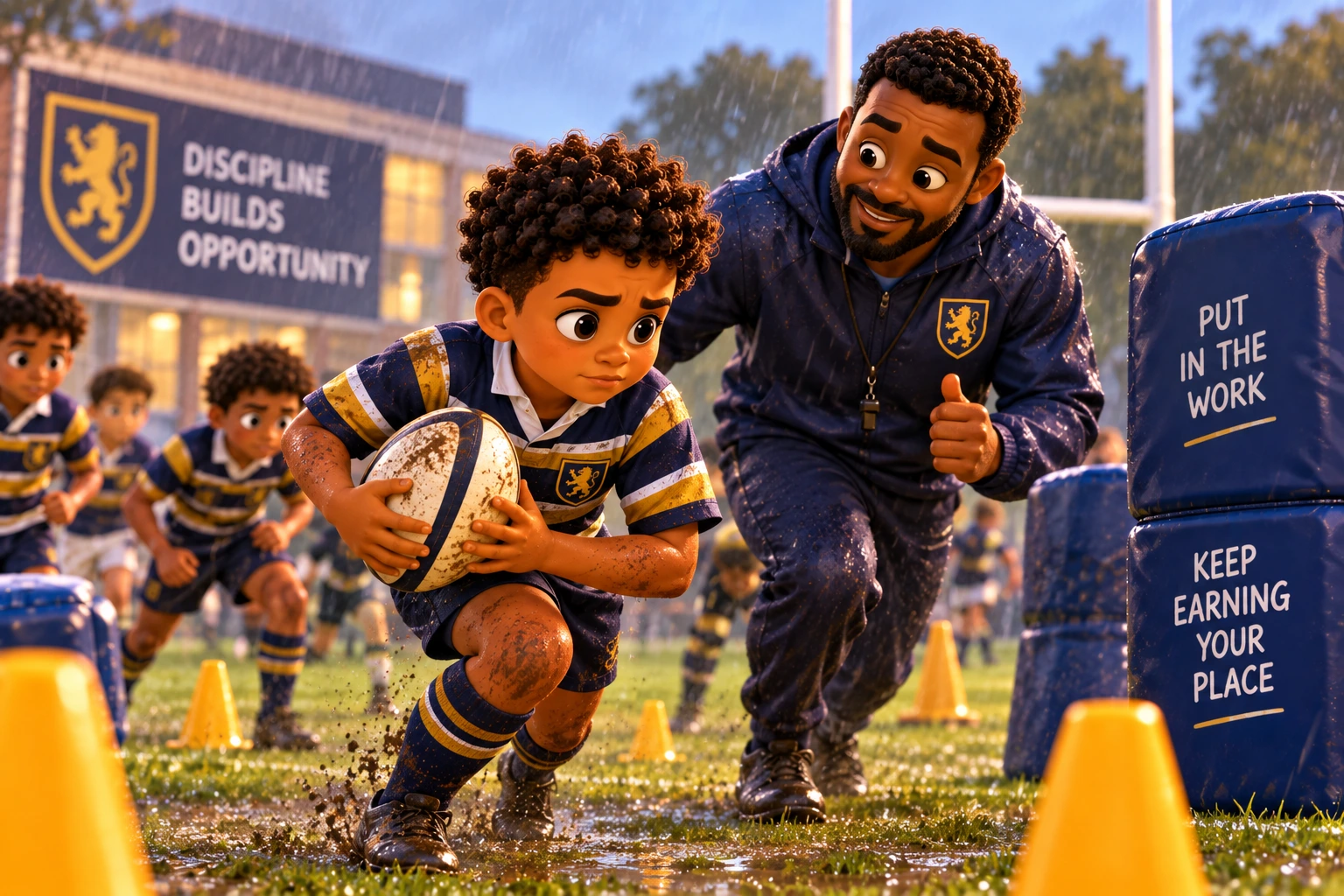
He arrived early. He stayed late. He did the drills he hated — the ones on his weaker side. He didn’t argue when the coaches corrected him. He didn’t sigh. He didn’t roll his eyes.
His dad woke him up in the morning Sometimes before his alarm and then walked with him every morning at 5:30.
His dad would say, “reflect on being a better version of yourself.”
Slowly, his name came back onto the team sheet.
Then came the match against Taunton School. It was raining sideways. Raphael played the full eighty minutes. He made two try-saving tackles, scored once, and gave an assist.
At the end, the referee called him over.
“Man of the Match.”
The Interview
Afterward, a reporter from the school magazine held up a recorder.
“Raphael, brilliant performance. What changed for you?”
Raphael thought about the phone. About the pep talk he’d thrown away. About the low level. About the morning walks.
“Nothing was a given,” he said. “I thought it was. I thought I’d earned it, so it was mine. But you have to keep earning it. Every day.”
The reporter nodded. “And who helped you see that?”
“My friend Ella,” Raphael said. “And my mum and dad. And my coaches, when they were honest with me.”
“And your message to other young players?”
Raphael grinned. “Be humble. Say sorry. Do the work. And don’t wait for someone else to make the first move.”
Back at School
Ella was waiting at the gates on Monday morning. She has seen the score sheet on the school website
“Man of the Match,” she said, on citing Raphael coming off the KB coach.
“In the rain,” Raphael confirmed.
Ella smiled. “Now that’s the whole lesson.”
They walked into school together.
“So,” Ella said. “Do you have the phone today?”
Raphael laughed. “No. I asked Mum if I could have it today. She said no. I said, ‘Fair enough.'”
“Progress,” Ella said.
“Progress,” Raphael agreed.
What Raphael and Ella Learned About Entitlement:
Lesson and What It Means
- Nothing is a given; Even things you’ve earned must be kept, daily
- Privileges aren’t rights; Trust, a place in a team, and a phone are all decisions made by others
- Silence can be hurt; When a parent goes quiet, they’re often waiting for an apology
- Own your mistakes; Blaming others keeps you stuck
- Apologise first; Don’t wait to be asked. Don’t wait to be chased.
- Words are cheap; Apologies mean nothing without changed behaviour
- Humility opens doors; Entitlement closes them
- Do the work; No apology earns back a place — the work does
- Don’t apologise to get a reward; Apologise because you were wrong