
Raphael and Ella: The Open Door

A Children’s Story About Focus, Supervision, and Earning Trust Back
The Playground Conversation
Ella found Raphael at the usual spot — the low wall by the sports hall. Except this time he wasn’t sad. He was annoyed.
“Raphael? What’s happened?”
“My mum won’t let me study with my door shut.”
Ella blinked. “That’s it?”
“That’s it?” Raphael repeated. “Ella, I can’t concentrate with someone checking on me every ten minutes. She comes up, opens the door, looks at my screen, nods, and leaves. Then ten minutes later she’s back.”
“Has she said why?”
Raphael sighed. “She said it’s because of the phone thing. And because she found out I’ve been watching YouTube clips while I’m supposed to be revising. She said I haven’t earned the right to be left alone yet.”
Ella nodded slowly. “And is she right?”
Raphael opened his mouth to argue — then closed it again.
“That’s a very telling pause,” Ella said.
What Really Happened
“Alright,” Raphael admitted. “Last Tuesday I said I was doing geography. I had the textbook open. But I was actually watching a video about a man building a swimming pool out of a shipping container.”
“Did you do any geography?”
“Some. Eventually. After about forty minutes.”
“And the day before?”
“Reaction videos. But only twenty minutes.”
“And the day before that?”
Raphael went quiet. “Maybe forty-five.”
Ella folded her arms. “So your mum has caught you three times in a week, and you’re surprised she doesn’t trust you with a closed door?”
“That’s not fair. I can focus when I want to.”
“Then show her,” Ella said. “Not by arguing. By doing it.”
The Argument
Raphael had tried arguing that morning. He’d come downstairs and said, “Mum, I need privacy to study properly. Can I please shut my door?”
His mum hadn’t even looked up from the washing up.
“Raphael, three times last week I found you watching videos and reading comments instead of revising. You want me to trust you with a closed door? Show me you can be trusted with an open one.”
“But I’ll focus — ”
“You said that last week too.”
Raphael had gone upstairs angry. He’d slammed his door — then opened it again, because his mum had called up, “Leave that open, please.”
He sat at his desk and stared at his maths book for twenty minutes. He didn’t do a single question.
What Ella Suggested
“Can I tell you something?” Ella said. “My dad’s the same. Except it’s the piano.”
Raphael looked up. “What do you mean?”
“When I was practising badly — just messing about, playing the same bit over and over, not doing my scales — Dad would sit in the room. Not because he didn’t trust me. Because I clearly wasn’t working.”
“That’s so annoying.”
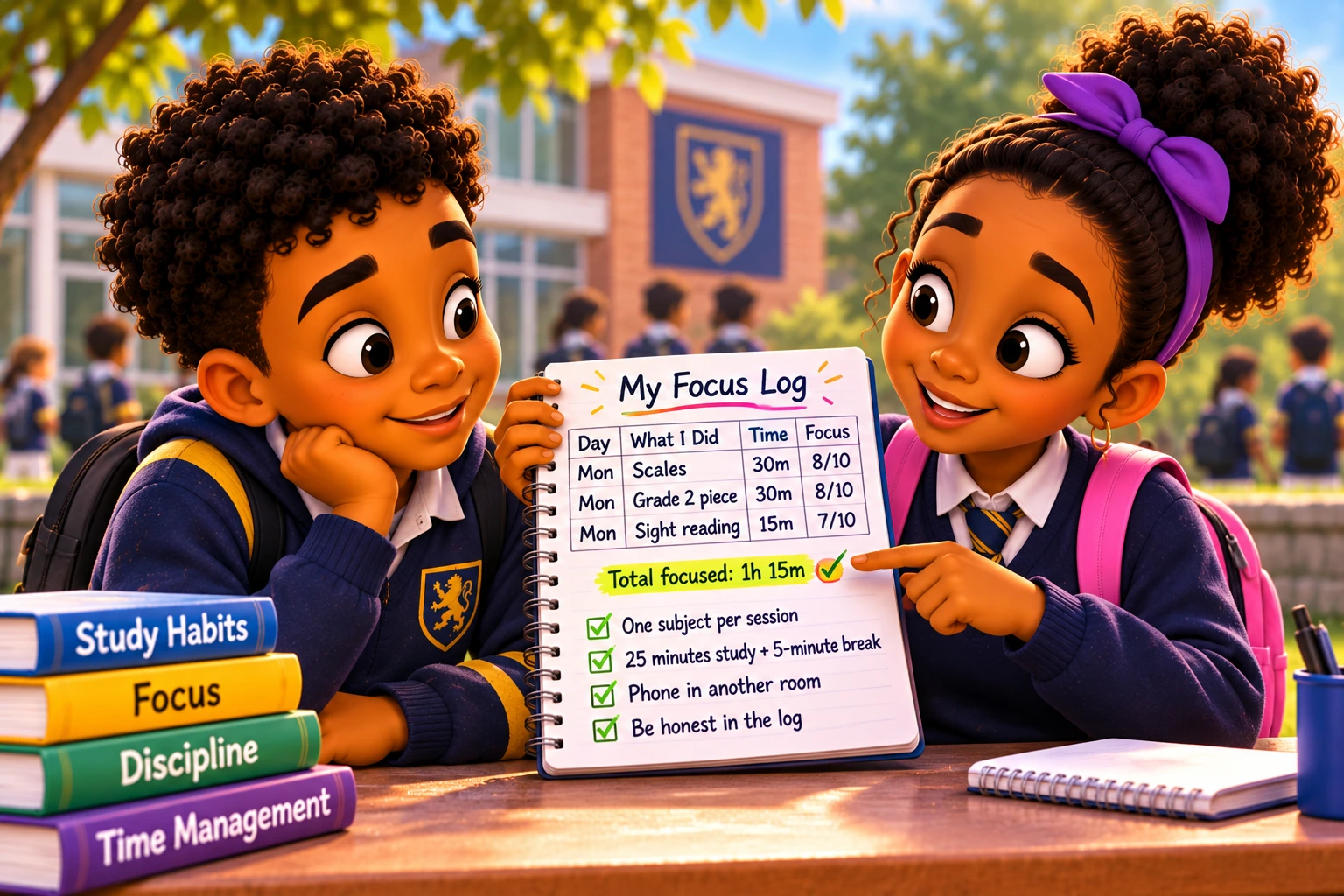
“It was,” Ella agreed. “So I started doing this.” She pulled out her phone and showed him a note.
Ella’s Focus Log
It was a simple table.
“`
Monday
7:00–7:30 Scales (all four)
7:30–8:00 Grade 2 piece — bars 1–16, slow
8:00–8:15 Sight reading
Total focused: 1h 15m
“`
“What’s this?”
“A focus log,” Ella said. “I write down what I actually did, for how long, and how focused I felt — out of ten.”
“Why?”
“Because Dad stopped needing to watch me. He could see it on the page. If I’d done the work, it was there in black and white. If I hadn’t, he’d know — but not because he was checking on me. Because I told him myself.”
Raphael studied the note. “You just… told on yourself?”
“I was honest,” Ella said. “That’s different. Honest people don’t need supervising.”
The Rule Ella Gave Him
Ella drew a line under the table.
“Here’s what you do. Tonight, ask your mum for one proper chance. One. Then keep a log like this. And follow three rules.”
Rules and Why
Phone in another room – You can’t check YouTube if it’s downstairs
One subject per session Not geography and maths and a bit of English
Twenty-five minutes studying then Five-minute break – Focus is a muscle. It gets tired
“And Raphael — the honest bit matters most. If you watched ten minutes of something, write it down. If you don’t, the whole thing falls apart.”
Raphael looked at the log. “You make it sound so simple.”
“It is simple,” Ella said. “It’s just not easy.”
That Evening
Raphael found his mum in the kitchen.
“Mum. Can I show you something?”
He put a blank focus log on the table.
“I’m going to track my study properly. Every session. What I did, how long, and a focus score out of ten. And I’ll show you every night, whether it’s good or bad.”
His mum picked it up. “And what do I do with it?”
“You don’t have to come and check on me. I’ll bring it to you. But —” he hesitated, “— I know I have to actually do the work. Not just write it down.”
His mum looked at him for a long moment.
“Alright,” she said. “One week. Door stays open. Log every night. And Raphael — if you write something down that you didn’t do, we’re back to square one, and it’ll be a long time before I try this again.”
“I know,” Raphael said. “I won’t.”
The First Week
Monday was hard. The phone was downstairs. Raphael finished his maths in twenty-five minutes and then just sat there, fidgeting, wanting something to happen.
Tuesday was worse. He kept getting up to get water. He went to the toilet three times in forty minutes.
Wednesday, something clicked. Twenty-five minutes went past and he hadn’t noticed.
Thursday he did two sessions back to back.
Friday, he logged honestly:
“`
Friday
5:00–5:25 Science revision — digestion. Focus 7/10
Break
5:30–5:55 Science questions. Focus 9/10
5:55–6:05 Watched video (chose to, after work was done)
Total focused: 50m
“`
His mum read it and looked up. “You’ve written down the video.”
“It was after I’d finished. But I wanted you to know.”
“That’s the most honest thing in this whole log,” his mum said.
The Door
On Saturday morning, Raphael came downstairs.
“Mum, I’ve got a two-hour revision block planned. Can I shut my door?”
His mum looked at the week’s logs on the fridge, all five of them.
“Yes,” she said. “Shut the door.”
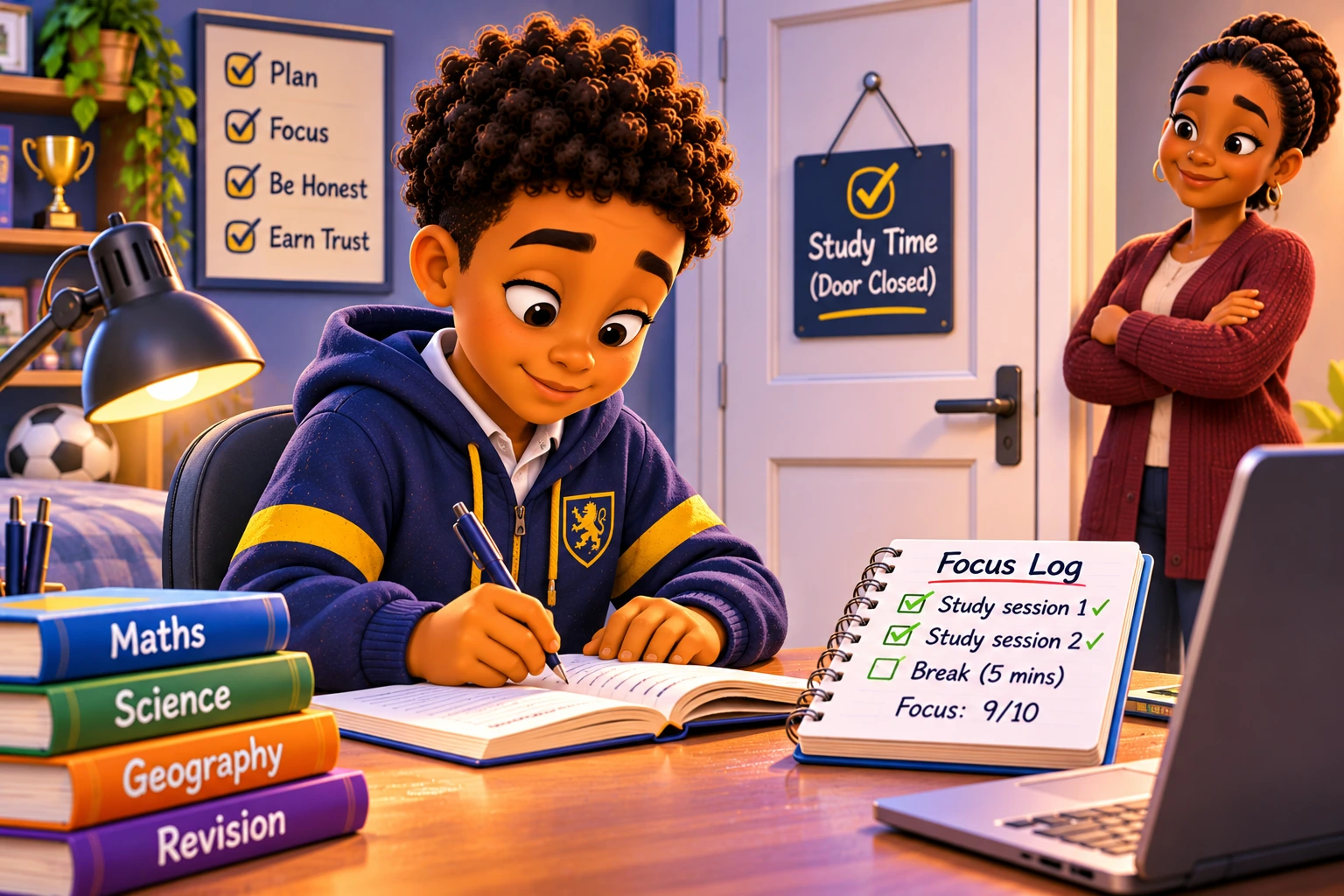
Raphael felt something lift in his chest. It wasn’t the closed door that mattered. It was that she’d decided he could have it.
Back at School
At break, Raphael found Ella.
“The door’s shut,” he said, grinning.
Ella laughed. “The door’s shut!”
“She said she stopped needing to check because the log told her everything. She said honest people don’t need supervising.”
“Honest people don’t need supervising,” Ella repeated. “That’s the whole thing.”
Raphael nodded. “I also found out something. I thought focus was about not wanting to watch YouTube. But it’s not. I still want to. I just… put it somewhere else until later.”
“That’s exactly what focus is,” Ella said. “It’s not having no distractions. It’s choosing your work before the distraction.”
Three Weeks Later
Raphael’s science test came back. A “B-plus,” up from a “D” at the start of term.
He brought it home and put it on the table next to the focus log.
His mum read the test, then the log, then the test again.
“Raphael,” she said quietly. “This is because you did the work.”
“I know,” he said.
“No,” his mum said. “I want you to hear me say it. This wasn’t luck. This wasn’t talent. This was you, sitting in a room, doing something boring, for three weeks.”
Raphael grinned. “My door was shut.”
“Your door was shut,” his mum agreed, and pulled him into a hug.
What Raphael and Ella Learned About Focus:
Lesson & What It Means
- Focus is a muscle It gets tired. Train it in short blocks.
- Show, don’t argue You can’t talk your way into trust — you work your way in
- Be honest about the bad days ; A truthful log is worth more than a perfect one
- Phone in another room; Willpower is weaker than distance
- One subject at a time; Multitasking is just switching, and switching costs you
- Distraction doesn’t vanish; You learn to put it aside until later
- Privacy is earned; Supervision is a bridge, not a punishment
- Honest people don’t need supervising; Transparency buys freedom