

A Children’s Story About Appreciating What You Have and Showing Thankfulness
The Calculator Incident
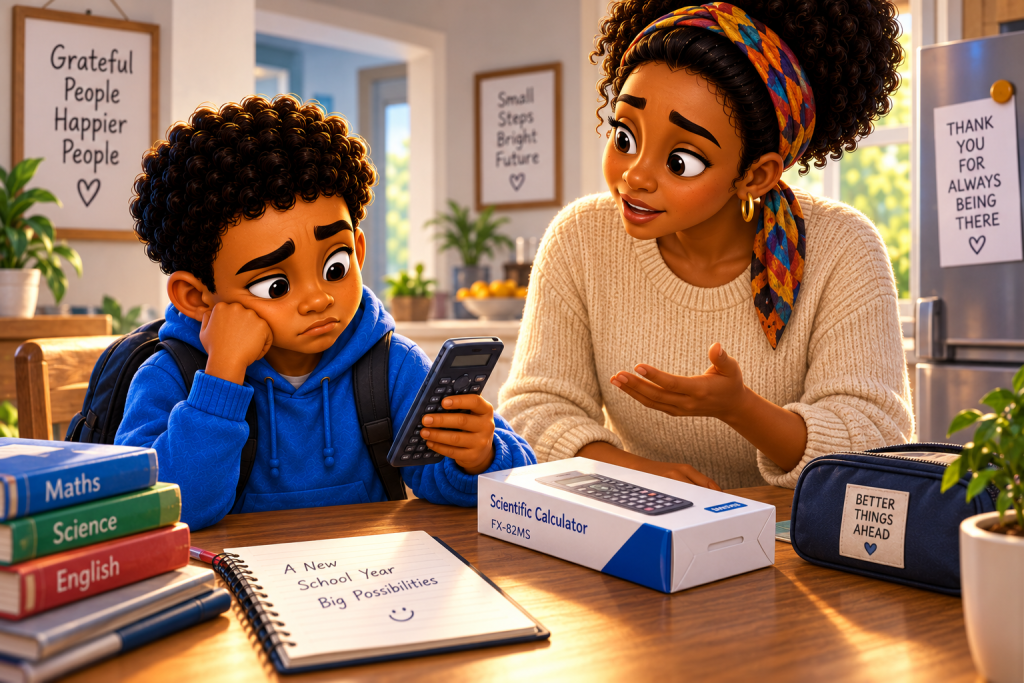
It was the start of the new school year. Raphael’s mum handed him a brand-new calculator.
“Here you go, Raphael,” she said with a smile. “Your old one broke, so I got you a replacement.”
Raphael took the calculator. He turned it over in his hands. It wasn’t the Casio brand he previously had. It was a different make.
“Mum, why didn’t you get the Casio one?” Raphael asked, frowning. “Everyone in my class has the Casio. This one looks… basic.”
His mum’s smile faded. “Raphael, I spent my lunch break finding this for you. I had to visit three shops. Your old calculator broke because you left it on the floor and your friend stepped on it—even though I’ve told you a hundred times to put your things away.”
“But it wasn’t my fault!” Raphael argued. “Ella dropped it by accident!”
“Raphael, it doesn’t matter who dropped it,” his mum said firmly. “What matters is that I went out of my way to get you a new one, and instead of saying thank you, you’re complaining about the brand.”
Raphael opened his mouth to argue, but his mum held up her hand.
“This isn’t the first time, Raphael. Do you remember when Auntie Wettie came to take you to swimming because I couldn’t? You kept her waiting for twenty minutes while you finished your game. She took time out of her day to help us, and you couldn’t even say thank you properly.”
Raphael looked down at his feet. He remembered that day. He had been annoyed that his game was interrupted. He hadn’t thought about Auntie Wettie’s time at all.
The Doctor’s Appointment
A few days later, Raphael’s mum took time off work to take him to the doctor. He had been complaining about his ears for weeks, but whenever his mum mentioned it, he brushed her off.
“There’s nothing wrong with my ears!” Raphael insisted as they sat in the waiting room. “Why are we even here? You didn’t have to take time off work. I’m fine!”
His mum took a deep breath. “Raphael, I took a half-day off work. I lost pay for this appointment. I did it because I care about you. The least you could do is be grateful that I’m here.”
Raphael crossed his arms. “I didn’t ask you to take time off.”

His mum’s eyes filled with frustration. “That’s exactly my point. You don’t ask. You don’t appreciate. You just expect. Do you remember what happened when I asked if you’d practised your guitar?”
Raphael looked away.
“Nothing,” his mum continued. “You haven’t practised in weeks. I pay for those lessons every single week. Your guitar teacher shows up on time every Thursday. And you can’t even bother to pick up the guitar for ten minutes.”
Raphael’s cheeks burned.
“That’s ingratitude, Raphael,” his mum said quietly. “When someone gives you something—time, money, effort—and you act like it doesn’t matter. Like it’s not enough. Like you deserve more.”
The Uncomfortable Silence
The doctor’s appointment went fine. There was nothing wrong with Raphael’s ears after all. But the car ride home was silent. Raphael’s mum didn’t speak. Her jaw was tight. Her hands gripped the steering wheel.
Raphael wanted to say something. He wanted to apologise. But the words felt stuck.
That morning, he went to school feeling heavy and sad.
Ella Notices
At playtime, Ella found Raphael sitting alone on the bench. His shoulders were slumped. His eyes looked tired.
“Raphael, what’s wrong?” Ella asked gently. “You look miserable.”

Raphael sighed. “I had a huge argument with my mum. She got me a new calculator for school, but I complained because it wasn’t the brand I wanted. Then she brought up how I kept Auntie Wettie waiting, and how I argued about going to the doctor, and how I never practise my guitar even though she pays for lessons.”
Ella listened carefully. “That sounds like a lot.”
“Now my mum is really upset with me,” Raphael continued. “She said I’m ungrateful. And I think she might be right.”
Ella sat beside him. “Raphael, do you know what gratitude is?”
“Being thankful?” Raphael guessed.
“More than that,” Ella said. “Gratitude is noticing what people do for you. It’s saying thank you—and meaning it. It’s showing people that you value their time and effort.”
Raphael thought about it. “Like when you helped me with maths last week? I said thank you.”
“Yes, you did,” Ella said. “And I appreciated that. But imagine if you had complained that I didn’t explain it well enough. Or if you’d said, ‘Why didn’t you show me another way?’ How would that have felt?”
Raphael winced. “That would have been really rude.”
“Exactly,” Ella said. “Your mum took time out of her day to get you a calculator. She took time off work to take you to the doctor. She pays for your guitar lessons. And instead of saying thank you, you complained, argued, and ignored her efforts.”
Raphael’s eyes stung. “I didn’t mean to be ungrateful. I just didn’t think.”
“That’s the thing about gratitude,” Ella said gently. “You have to practise it. You have to stop and think: What did someone do for me today? How did they help me? And then you have to say thank you—and show it.”
Raphael’s Apology
That evening, Raphael found his mum in the kitchen. She was cooking dinner, her back turned to him.
“Mum?” Raphael said quietly. “Can I talk to you?”
His mum turned around. Her eyes were still sad.
“I’m sorry,” Raphael said. “I was ungrateful about the calculator. And about Auntie Wettie. And about the doctor. And the guitar lessons. You do so much for me, and I’ve been acting like it doesn’t matter.”
His mum’s expression softened.
“I appreciate everything you do,” Raphael continued. “You work hard. You take time off for me. You pay for my lessons. You buy me things. And I’ve been complaining instead of saying thank you.”
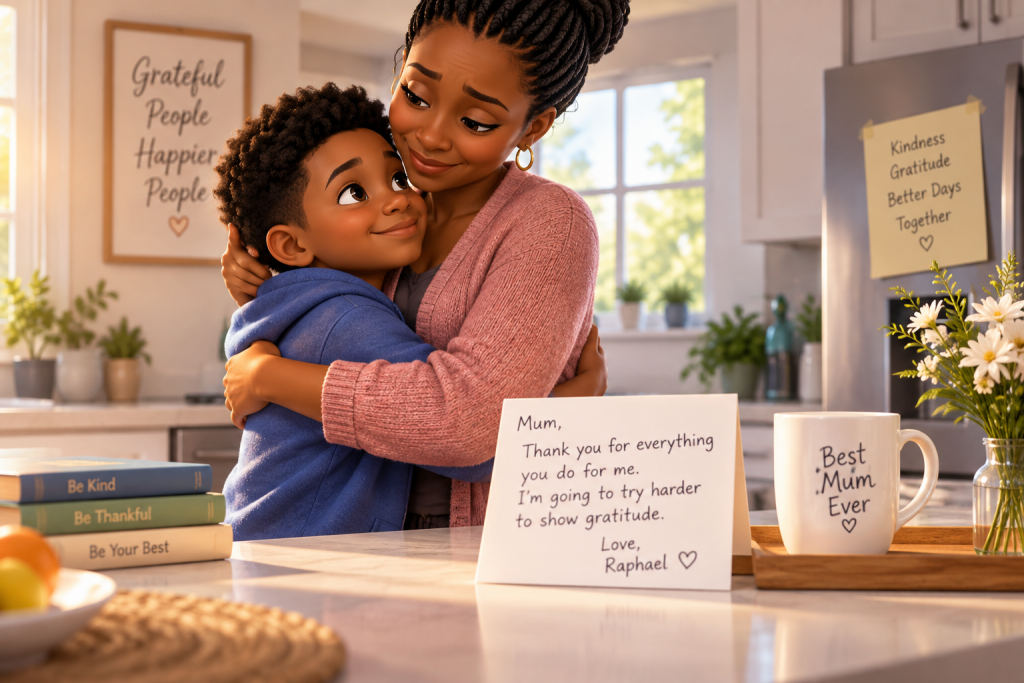
His mum walked over and pulled him into a hug.
“Thank you, Raphael,” she whispered. “That means more than you know.”
The Next Day
The next morning, Raphael found his mum’s favourite coffee mug and made her a cup of tea. He also wrote a short note and left it on the kitchen table.
It read:
“Mum, thank you for everything you do for me. I’m going to try harder to show gratitude. Love, Raphael.”
When his mum saw the note, her eyes filled with happy tears.
At school, Raphael saw Ella and smiled. “I apologised to my mum. It felt really good.”
Ella grinned. “That’s gratitude in action. It’s not just saying thank you—it’s showing it.”
Raphael nodded. “From now on, I’m going to wear my gratitude glasses. I’m going to notice what people do for me—and I’m going to show them I appreciate it.”
“You already are,” Ella said. “And I’m proud of you.”
What Raphael and Ella Learned About Gratitude:
Gratitude is noticing Pay attention to what others do for you
Say thank you and mean it. A genuine thank you makes people feel valued
Don’t complain about gifts. Be thankful for what you receive, even if it’s not perfect
Value other people’s time. When someone helps you, don’t keep them waiting
Appreciate effort. People take time and money to support you—show you notice
Practise gratitude daily. It’s a habit you have to build
Gratitude strengthens relationships. Thankfulness brings people closer
Ingratitude hurts people. Complaining and arguing makes others feel unappreciated